PATHETIC POEM
What kind of noise is that on the stairs?
It is love coming to an end,
It is the man who closed the door
And hanged himself in the curtains>
What kind of noise is that on the stairs?
It is Guiomar who covered her eyes
And blew her nose fortissimo.
It is the still moon upon the plates
And the cutlery shining in the pantry.
What kind of noise is that on the stairs?
It is the dripping of the water faucet,
It is the inaudible lament
Of someone who has lost his gamble
While the music of the band
Goes down, down, down.
What kind of noise is that on the stairs?
It is the virgin with a trombone,
The child with a drum,
The bishop with a bell,
And someone who pianissimos the noise
Which jumps from my heart.
SECRET
You cannot communicate poetry.
Keep still in your corner.
Do not love.
I hear that there is shooting
Within reach of our body.
Is it a revolution? is it love?
Say nothing.
Everything is possible, only I am impossible.
The sea overflows with fish.
There are men who walk on the sea
As though they walked in the street.
Do not tell.
Suppose that an angel of fire
Swept the face of the earth
And the sacrificed men
Asked for mercy.
Beg nothing.
THE DIRTY HAND
My hand is dirty.
I must cut it off.
Useless to wash it.
The water is rotten.
Or to soap it.
The soap is no good.
The hand has been dirty
For many many years.
At first hidden
In the pocket of my trousers,
Who would know it?
People used to call me,
Offering me their hand.
Hard, I refused.
The hidden hand
Would spread its dark
Track through my body.
And I saw it was the same
To use it or put it away.
The disgust was the same.
Ah, how many nights
Way back in my house
I washed this hand,
I scrubbed it, I scoured it!
For greater contrast,
I wished I could turn it.
Into crystal or diamond,
Or even, at last,
Into a simple white hand,
The clean hand of a man,
Which you could hold
And lift to your lips
Or clasp in your own
In one of those moments
When two people confess
Without saying a word…
The incurable hand
Opened its dirty fingers.
It was a filthy dirt,
Nor dirt of earth,
not dirt of coal,
not dirt of a scab,
Not sweat of a shirt
Of one who has worked.
It was a sad dirt
Made from disease
And from mortal anguish
In the disgusted skin.
It was not black dirt —
The black so pure
In a white thing.
It was gray-brown dirt,
Gray-brown, dull, thistle.
Useless to keep
The ignoble dirty hand
Lying upon the table.
Quick, cut it off,
And through it into the sea!
With time, with hope
And is machinery,
Another hand will come,
Pure — transparent —,
And fasten itself to my arm.
SADNESS IN HEAVEN
In heaven also there is a melancholy hour.
A difficult hour, when doubt invades the souls.
Why did I make the world? God wonders
And answers: I did not know.
The angels at Him in disapproval.
Their feathers fall.
All the hypotheses: grace, eternity, love
Fall. They are feathers.
One feather more, and heaven is undone.
So quiet, no breaking noise tells
The moment between everything and nothing.
Tat is to say, the sadness of God.
THE DEAD IN THE FROCK COATS
In a corner of the drawing room was an album
of unbearable photographs,
Many meters high and infinite minutes old,
Over which everyone leaned
To make fun and to laugh at the dead in frock coats.
A worm began to eat the indifferent frock coats,
And he ate the pages, the dedications, and even
the dust on the pictures.
The only thing he did not eat was the inmortal
sob of life
Which broke from those pages.
THE OX
O solitude of the ox in the field,
O solitude of man in the street!
Amid cars, trains, telephones,
Amid screams, the profound aloneness.
O solitude of the ox in the field,
O millions suffering without a curse!
Whether it is night or day makes no difference,
Darkness breaks up with the dawn.
O solitude of the ox in the field,
Men writing without a word!
The city cannot be explained
And the houses have no meaning.
O solitude of the ox in the field!
The ghost ship passes
Silently trough the crowded street.
If a love storm should blow up!
The hands clasped, the life saved…
But the weather is steady. The ox is alone.
In the immense field: the oil derrick.
CONSOLATION AT THE BEACH
Come on, don´t cry…
Childhood is lost.
Youth is lost.
But life is not lost.
The first love is over.
The second love is over.
The third love is over.
But the hurt goes on.
You have lost your best friend.
You haven´t tried any traveling.
You won no house, ship, or land.
But you look at the sea.
You haven´t written the perfect book.
You haven´t read the best books
Nor have you love music enough.
But you own a dog.
A few harsh words,
In a low voice, have hurt you,.
Never, never have they healed.
But what about humor?
There is no resolution for injustice.
In the shadow of this wrong world
You have whispered a timid protest.
But others will come.
All summed up, you should
Throw yourself — once and for all — into the waters.
You are naked on the sand, in the wind…
Sleep, my son.
SEARCH FOR POETRY
Do not make verses about happenings.
For poetry, there is no creation or death.
In her eyes, life is an unmoving sun,
Which neither warms nor lights.
The attractions, the anniversaries, the personal incidents
do not matter.
Do not make poetry with the body.
This excellent, complete and comfortable body, so unfit
for lyrical flow.
Your drop of gall, your face-making of pleasure or of pain
in the dark
Are of no account.
Do not tell me your feelings,
Which capitalize on ambiguity and attempts the long journey.
What you think and feel, that is not yet poetry.
Do not sing your city, leave it alone.
The song is not the movement of the machines or the secret
of the houses.
It is not music heard in passing; nor the sound of the sea
in the streets near the edge of spume.
The song is not nature
Or men in society.
For it, rain and night, fatigue and hope mean nothing.
Poetry (do not make poetry out of things)
Eliminates subject and object.
Do not dramatizes, do no invoke,
Do not investigate. Do not waste time telling lies.
Do not be anxious.
Your ivory yacht, your diamond shoe,
Your mazurkas and superstitions, your family skeletons
Disappear in the curve of time, time are worhless.
Do not resurrect
Your buried and melancholy childhood.
Do not oscillate between the mirror
And your fading memory.
If it faded, it was not poetry.
If it broke, it was not crystal.
Penetrate deftly the kingdom of words:
Here lie the poems that wait to be written.
They are paralyzed, but not in despair,
All is calm and freshness on the untouched surface.
Here they are alone and dumb, in the state of the dictionary.
Before you write them, live with your poems.
If they are obscure, be patient. If they provoke you,
hold your temper.
Wait for each one to actualize and to consume itself
In the power of language
And the power of silence.
Do not force the poem to come out of Limbo.
Do not pick from the ground the poem that was lost.
Do not flatter the poem. Accept it
As it will accept its own form, final and concentrated
In space.
Come closer and contemplate the words.
Each one
Has a thousand secret faces under a neutral face
And asks you, without interest in the answer,
Poor or terrible, which you will give it:
Have you brought the key?
Please note:
Barren of melody and meaning,
The words have taken refuge in the night.
Still humid and saturated with sleep,
They roll in a difficult river and turn themselves
into despising.
DAWN
The poet was drunk in a streetcar.
Day was dawning behind the backyards.
The gay boarding houses were sleeping most sadly.
The houses also were drunk.
Everything was beyond repair.
Nobody knew the word was going to end
(Only a child guessed it but kept silent),
That the world was going to end at 7:45.
Last thoughts! final telegrams!
Joseph, who had mastered his pronouns,
Helen, who loved men,
Sebastian, who was bankrupting himself,
Arthur, who said nothing,
Set all for eternity.
The poet is drunk, but
He listens to an invitation in the dawn:
Shall we all go dancing
Between the streetcar and the tree?
Between the streetcar and the tree
Dance, my brothers!
Although there is no music
dance, my brothers!
Children are being born
With such spontaneity.
How marvelous is love
(Love and other products).
Dance, my brothers!
Death will come later,
Like a sacrament.
ASPIRATION
Id not want any longer the maternal adoration
Which finally exhausts us and then flashes in panic,
Neither do I want the feeling of a precious find
Like that of Katherine Kippenburg at the feet of Rilke.
And I do not want the love, under silly disguises,
Of that same nymph desolate in her hermitage,
Nor the constant search of thirst rather than of lymph
And neither do I want the simple rose of sex,
Hidden, meaningless, in the hostels of the wind,
Just I do not want the geometric friendship
Of souls who elected one another in a proud cultivation,
An overlapping, perhaps? of melancholy needs.
I aspire rather to a faithful indifference
But poise enough to sustain life
And, in its indiscrimination of cruelty and diamond,
Able to suggest the end without the injustice of prizes.
===================================================
From
AN ANTHOLOGY OF TWENTIETH-CENTURY BRAZILIAN POETRY
Edited, with introduction, by Elizabeth Bishop and Emanuel Brasil
Sponsored by the Academy of American Poets
Middletown, Conn.: Wesleyan University Press, 1972
POEMA DE SETE FACES
Quando nasci, um anjo torto
desses que vivem na sombra
disse: Vai, Carlos, ser gauche na vida.
As casas espiam os homens
que correm atrás das mulheres.
A tarde talvez fosse azul
não houvesse tantos desejos.
0 bonde passa cheio de pernas:
pernas brancas pretas amarelas.
Para que tanta perna, meu Deus, pergunta meu coração.
Porém meus olhos
não perguntam nada.
0 homem atrás do bigode
é sério, simples e forte.
Quase não conversa.
Tem poucos, raros amigos
o homem atrás dos óculos e do bigode.
Meus Deus, porque me abandonaste
se sabias que eu não era Deus
se sabias que eu era fraco.
Mundo mundo vasto mundo,
se eu me chamasse Raimundo,
seria uma rima, não seria uma solução.
Mundo mundo vasto mundo.
Mais vasto é meu coração.
Eu não devia te dizer,
mas essa lua
mas esse conhaque
Botam a gente comovido como o diabo.
SEVEN-SIDED POEM
Translated by Elizabeth Bishop
When 1 was born, one of the crooked
angels who live in shadow, said:
Carlos, go on! Be gauche in life.
The houses watch the men,
men who run after women.
If the afternoon had been blue,
there might have been less desire.
The trolley goes by full of legs:
white legs, black legs, yellow legs.
My God, why all the legs?
my heart asks. But my eyes
ask nothing at all.
The man behind the moustache
is serious, simple, and strong.
He hardly ever speaks.
He has a few, choice friends,
the man behind the spectacles and the moustache.
My God, why hast Thou forsaken me
if Thou knew'st 1 was not God,
if Thou- knew'st that 1 was weak.
Universe, vast universe,
if 1 had been named Eugene
that would not be what 1 mean
but it would go into verse
faster.
Universe, vast universe,
my heart is vaster.
I oughtn't to tell you,
but this moon
and this brandy
play the devil with one's emotions.
INFÂNCIA
Meu pai montava a cavalo, ia para o campo.
Minha mãe ficava sentada cosendo.
Meu irmão pequeno dormia.
Eu sozinho menino entre mangueiras
lia a historia de Robinson Crusoé.
Comprida historia que não acaba mais.
No meio-dia branco de luz urna voz que aprendeu
a ninar nos longes da senzala — e nunca se esqueceu
chamava para o café.
Café preto que nem a preta velha
café gostoso
café bom.
Minha mãe ficava sentada cosendo
olhando para mim:
— Psiu . . . Não acorde o menino.
Para o berço onde pousou um mosquito.
E dava um suspiro . . . que fundo!
La longe meu pai campeava
no mato sem fim da fazenda.
E eu não sabia que minha historia
era mais bonita que a de Robinson Crusoé.
INFANCY
Translated by Elizabeth Bishop
My father got on his horse and went to the field.
My mother stayed sitting and sewing.
My little brother slept.
A small boy alone under the mango trees,
1 read the story of Robinson Crusoe,
the long story that never comes to an end.
At noon, white with light, a voice that had learned
lullabies long ago in the slave-quarters — and never forgot —
called us for coffee.
Coffee blacker than the black old woman
delicious coffee
good coffee.
My mother stayed sitting and sewing
watching me:
Shh — don't wake the boy.
She stopped the cradle when a mosquito had lit
and gave a sigh . . . how deep!
Away off there my father went riding
through the farm's endless wastes.
And 1 didn't know that my story
was prettier than that of Robinson Crusoe.
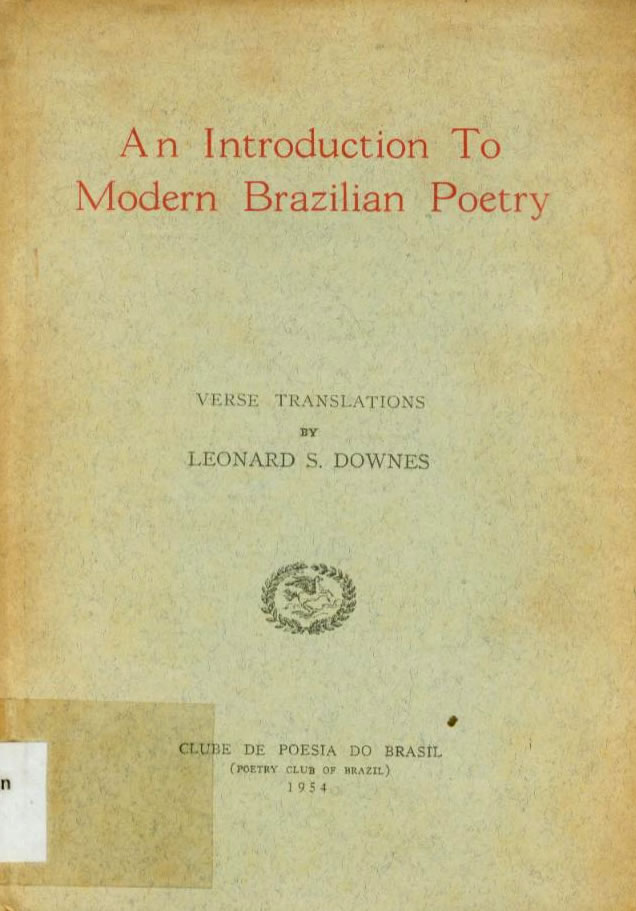
AN INTRODUCTION TO MODERN BRAZILIAN POETRY. Verse translations by Leonard S. Downes. [São Paulo]: Clube de Poesia do Brasil, 1954. 84 p. 14x20 cm. “ Leonard S. Downes “ Ex. Biblioteca Nacional de Brasília.
YOUR SHOULDERS HOLD UP THE WORLD
There comes a time when you can no longer say. My God.
A time of ultimate catharsis.
A time when you can no longer say, My love.
Because love has shown itself futile.
And your eyes refuse to weep.
And your hands will only go about their rough work.
And your heart is dry.
In vain women knock on your door; you will not open.
You are alone and the lamp has gone out,
But your eyes shine enormous in the dark.
You are full of certainty and suffer no more.
And you hope for nothing from your friends.
It does not matter if old-age comes, what is old-age?
Your shoulders hold up the world
And it weig'hs no more than a child's hand.
Wars and famines and discussions in clubs
Onlly prove that life goes on
And that not all have freed themselves yet.
Some, finding the spectacle barbarous
Prefer (the faint of heart) to die.
A tune has come in which it does not help to die.
A time has come in which life is an order.
Life unadorned, without mystifications.
THEY DIED IN FROCK-COATS
There was in a corner of the drawing-room an album[of terrible photos.
Many metres high and infinite minutes old,
At wihich everyone went to look
For the joy of mocking the dead in their frock-coats.
A worm. began to gnaw at the indifferent frock-coats And gnawed the pages, the dedications and even the dust[of the portraits.
Alone it did riot gnaw the sob of life which burst
Which burst from those old pages.
TRANSLATION BY ABGAR RENAULT
MENINO CHORANDO NA NOITE
Na noite lenta e morna, morta noite sem ruído, um menino chora.
O choro atrás da parede, a luz atrás da vidraça
perdem-se na sombra dos passos abafados, das vozes extenuadas.
E no entanto se ouve até o rumor da gota de remédio caindo na
colher.
Um menino chora na noite, atrás da parede, atrás da rua,
longe um menino chora, em outra cidade talvez,
talvez em outro mundo.
E vejo a mão que levanta a colher, enquanto a outra sustenta a
cabeça
e vejo o fio oleoso que escorre pelo queixo do menino,
escorre pela rua, escorre pela cidade (um fio apenas).
E não há ninguém mais no mundo a não ser esse menino chorando.
CHILD WEEPING IN THE NIGHT
In the slow, warm night, dead noiseless night, a child weeps.
Its weeping behind the wall and the light behind the window-pane
vanish away in the dark of silent steps, of worn-out voices.
Yet, one hears the soft sound of the drops of medicine as the drip
into the spoon.
A child weeps in the night, behind the wall, behind the street,
a child weeps away, perhaps in another town,
perhaps in another world.
And I see the hand that lifts the spoon and the hand that props
its head;
and the oily drops that flow down in the child’s chin;
flow down the street, flow across the town (only a few drops).
And there is no one else in the world but this child weeping.
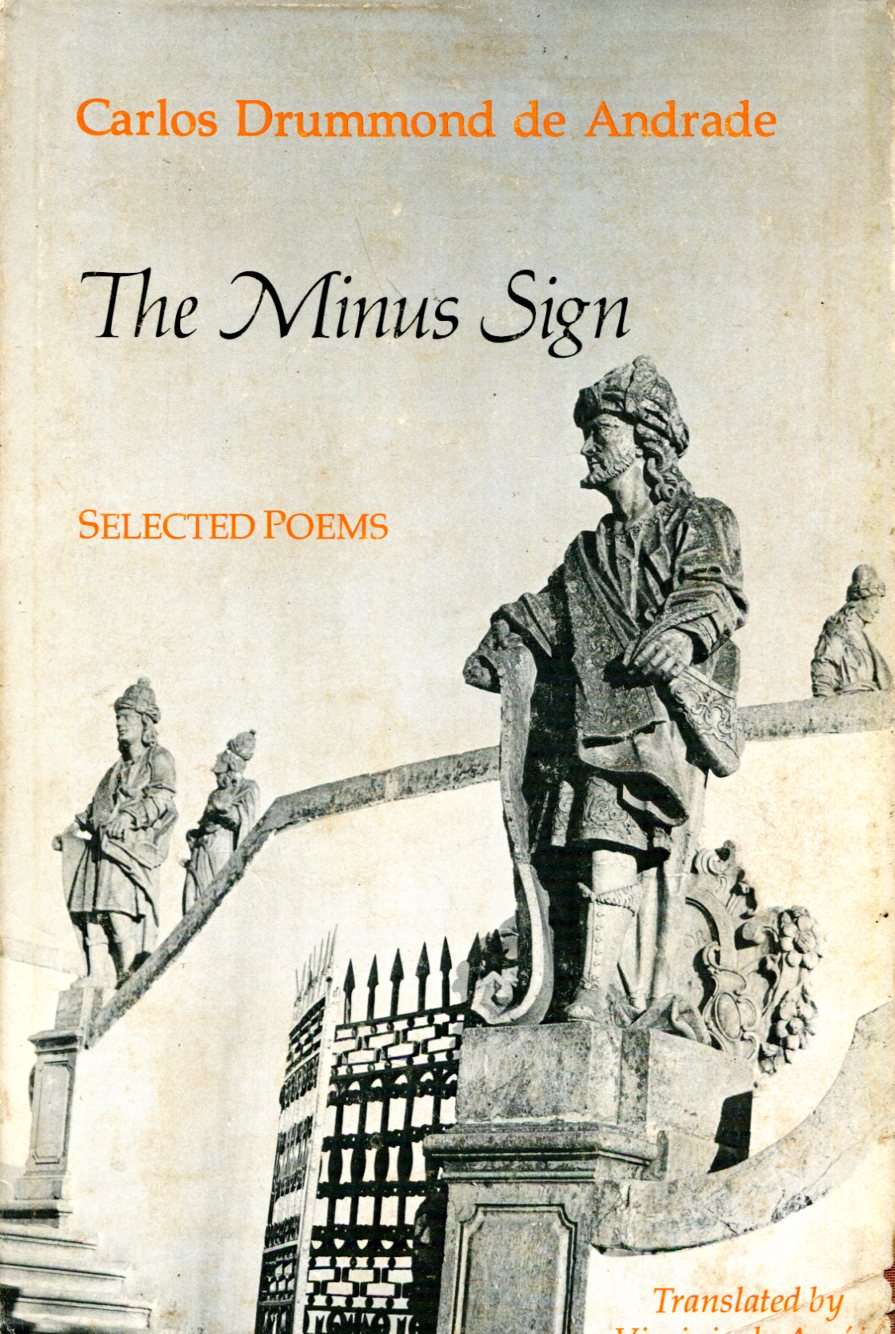
ANDRADE, Carlos Drummond de. The Minus Sign. Selected Poems. Translated by Virginia de Araújo. Redding Ridge, CT, U.S.A.: Black Swan Books Ltd., 1980. capa dura sobrecapa 14,5 X 21,5 cm ISBN 0-9338-0603-5 Ex.. bibl. Antonio Miranda
POEM WITH SEVEN FACES
WHEN I WAS BORN, a crooked angel
the kind that lives in shadow
said: Go, Carlos, be gauche in life.
The houses mount surveillance
on the women-chasers.
Maybe if the afternoon were blue
there would be fewer desires.
The trolley passes packed with legs:
white legs, black and yellow ones.
Why so many legs, my God, my heart asks.
However my eyes
raise no questions.
The man behind the mustache
is serious, strong and simple.
He hardly talks.
He has few, precious friends
the man behind the glasses and mustache.
My God, why hast Thou forsaken me
knowing I wasn't God
knowing how weak I am.
Sphere sphere vast sphere
if I were a sonneteer
it would be a rhyme, not a solution.
Sphere sphere vast sphere
more vast is my emotion.
I oughtn´t to tell you
but this moon
but this cognac
work on a man´s feelings like the devil.
(Poema de sete faces)
PATHETIC POEM
WHAT RACKET IS THAT on the stairs?
It's love, crashed to a close,
it's the man who pulled the drape
and hung himself on the cord.
What racket is that on the stairs?
It's Guiomar who hid her eyes
and blew her nose in a rag.
It's the motionless moon on the plates,
on the pans over the sink.
What racket is that on the stairs?
It's the faucet, it's got a leak.
It's the imperceptible complaint
of someone who lost the game
}while the music of the band
got harder and harder to hear.
What racket is that on the stairs?
It's the virgin with a trombone,
the child with a snare drum,
the bishop, bell in hand,
and someone muffling the sound
in the cavity of my chest.
(Poema patetico)
JOSÉ
And now, José?
The party's done,
the light put out,
the people gone,
the night gone cold,
and now, Jose?
and now, yourself?
your nameless self
who cuts them dead,
you maker of verse
who loves, protests,
and now, José?
You're loverless,
no podium,
no tenderness,
drink won't go down,
smoke won't suck in,
the mouth won't spit,
the night's gone cold,
dawn hasn't come,
the bus won't come
nor laughter come
nor Utopia come
and it's all done
and it's all fled,
the white mold grows,
and now, José?
And now, José?
your gentle word,
your flash of fever,
your greeds and fasts,
your library,
your vein of gold,
your suit of glass,
your incoherences,
your hates, and now?
Key in your hand,
you want the door,
there's no more door;
you want to drown
but the sea dried up;
you want your home
—what home is that?
José, what next?
If you'd just scream,
if you'd just whine,
if you'd just play
a Viennese waltz,
if you'd just sleep
or at least get tired,
if you'd just die ...
But you won't die,
you're tough, José!
Yourself in the dark
like a beast in a den,
with no pagan gods,
with no bare wall
to lean back on,
with no jet horse
that flees at a gallop,
you march, José!
José, how come?
(José)
QUADRILLE
JOAO LOVED TERESA who loved Raimundo
who loved Maria who loved Joaquim who loved Lili
who loved no one.
Joao went to the United States, Teresa to a convent, Raimundo died in an accident, Maria missed her
chance,
Joaquim killed himself and Lili married J. Pinto
Fernandes, not one of the original cast.
(Quadrilha)
ANTHOLOGY OF CONTEMPORARY LATIN-AMERICAN POETRY. Edited by Duddley Fitts. Norfolk Conn. A New Directions Book, 1942. 667 p. Capa dura revestida de tecido. Inclui os poetas brasileiros: Jorge de Lima, Ismael Nery, Murilo Mendes, Manuel Bandeira, Ronald de Carvalho, Menotti del Picchia, Carlos Drummond de Andrade.
Translation by Dudley Poore
FANTASIA
In a sky of methylene blue
the moon, ironical, diuretic,
composes a print for the dining room.
Guardian angels on nocturnal rounds
keep watch over adolescent dreams
scaring mosquitoes
from the curtains and garlands of the bed.
Up the spiral staircase, they say, the foolish virgins, embodied in the milky way, glimmer like fireflies.
Through a chink
the devil peers with a squinting eye.
The devil has a telescope
that sees for seven leagues
and his ears are as fine
as a violin's.
Saint Peter sleeps
and the clock of heaven mechanically snores.
The devil peers through a chink.
Down there,
crushed lips are sighing.
Sighing prayers ? They sigh lightly
with love.
And the entwined bodies
twine more closely still
and love invades love.
God's will be done!
Two or three may be spared,
the rest are all going to hell.
FANTASIA
No azul do céo de methyleno
a lua irónica
diurética
compõe uma gravura de sala de jantar.
Anjos da guarda em expedição nocturna
velam somnos púberes
espantando mosquitos
dos cortinados e grinaldas.
Pela escada em espiral
diz que tem virgens tresmalhadas,
incorporadas á via-lactea,
vagalumeando...
Por uma frincha
o diabo espreita com o olho torto.
Diabo tem uma luneta
que varre léguas de sete léguas
e tem o ouvido fino
que nem um violino.
S. Pedro dorme
e o relógio do céo ronca mecânico.
Diabo espreita por uma frincha.
Lá em baixo
suspiram boccas machucadas.
Suspiram rezas? Suspiram manso,
de amor.
E os corpos enrolados
ficam mais enrolados ainda
e a carne penetra na carne.
Que a vontade de Deus se cumpra!
Tirante dois ou tres
o resto vae para o inferno.
GARDEN IN LIBERTY SQUARE
SWAYING greenery.
Caressing music of wáter
flowing between geometrical roses.
Elysian winds.
Sleek turf.
Garden so little Brazilian, and yet so lovely.
Landscape without depth.
It cost the earth no pain to yield these flowers.
Landscape without echoes.
Each moment that passes
unfolding in unpremeditated bloom.
Too pretty. Too inhuman.
Too literary.
(Poor gardens of the wilds of my country
beyond the Serra do Curral!
With neither cool fountains, nor languid pools,
with no running water, no appointed gardeners.
Only the dry thicket, carelessly growing among
tarnished evergreens
and the forlorn face of a girl tearing the daisy petals apart.)
Garden in Liberty Square
Versailles among streetcars.
In the frame of the brooding Ministries
the conscious grace of the lawns
composes a revery of green.
DO NOT WALK ON THE GRASS
Perhaps it were better to say:
DO NOT EAT THE GRASS
The watchful Prefecture
stands guard ver the slumber of the grass-blades.
And the black clock of the watchman is a banner
in the night starred with guards.
Suddenly a negro brass band,
sweating in pure vermilion,
bresaks into a rousing military march
in the stillness of the garden.
Startled fountains take flight.
JARDIM DA PRAÇA DA LIBERDADE
Verdes bolindo.
Sonata cariciosa da agua
fugindo entre rosas geométricas.
Ventos elysios.
Macio.
Jardim tão pouco brasileiro ... mas tão lindo.
Paisagem sem fundo.
A terra não soffreu para dar estas flores.
Sem resonancia.
O minuto que passa
desabrochando em floração inconsciente.
Bonito demais. Sem humanidade.
Literário demais.
(Pobres jardins do meu sertão
atrás da Serra do Curral!
Nem repuxos frios nem tanques langues,
nem bombas nem jardineiros officiaes.
Só o matto crescendo indifferente entre semprevivas
desbotadas
e o olhar desditoso da moça desfolhando malmequeres.)
Jardim da Praça da Liberdade,
Versailles entre bondes.
Na moldura das Secretarias compenetradas
a graça inteligente da relva
compõe o sonho dos verdes.
PRHIBIDO PISAR NO GRAMADO
Talvez fosse melhor dizer:
PROIBIDO COMER O GRAMMADO
A Prefeitura vigilante
véla a somneca das hervinhas.
E o capote preto do guarda é uma bandeira na
noite estrellada de funccionarios.
De repente uma banda preta
vermelha retinta suando
bate um dobrado batuta
na doçura do jardín.
Repuxos espavoridos fugindo.
FROM:
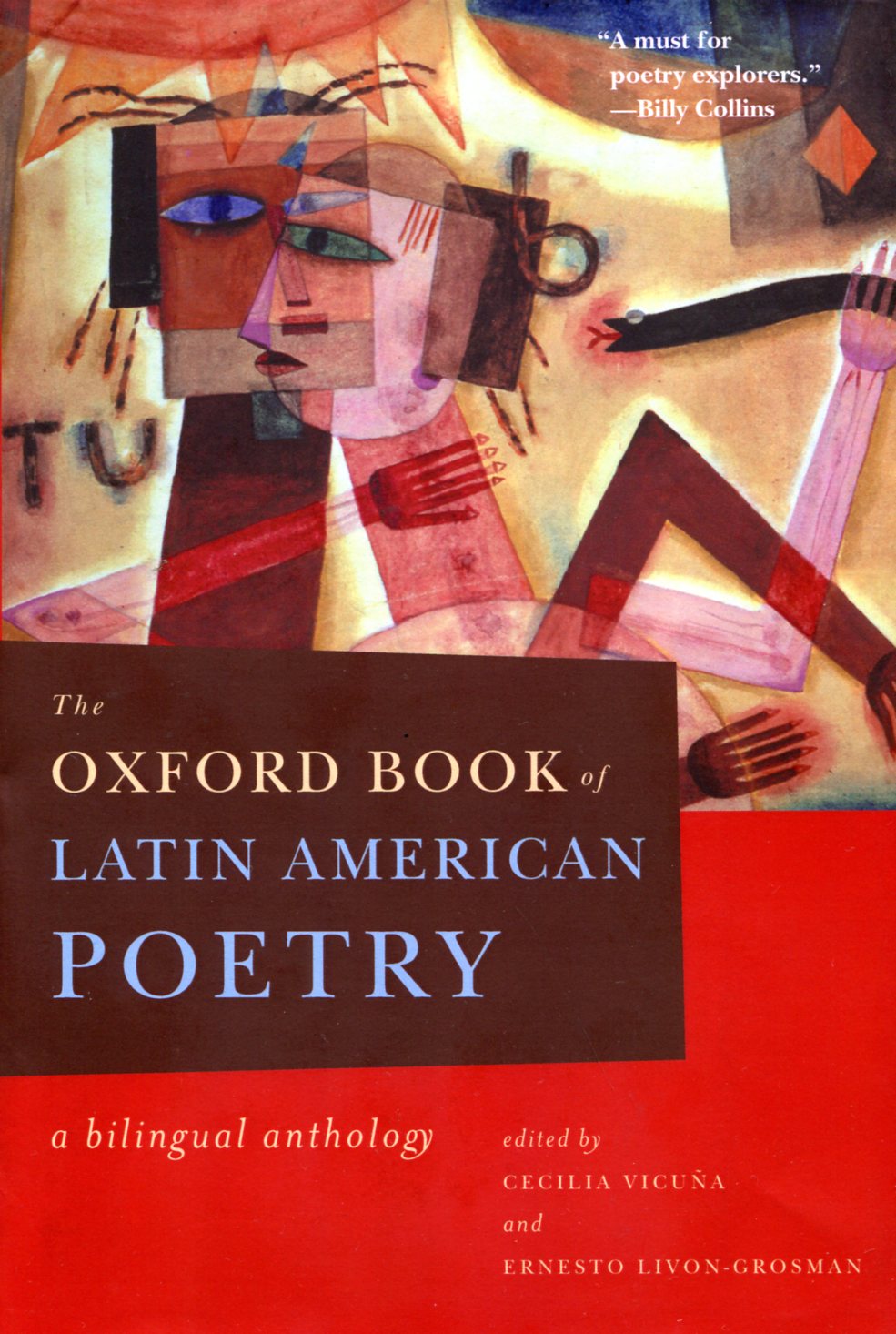
THE OXFORD BOOK OF LATIN AMERICAN POETRY: a bilingual anthology edited by Cecilia Vicuña and Ernesto Livon-Grosman. Agawam. MA, USA: Oxford University Press, 2009. 561 p. 16x24,5 cm. Contracapa, capa dura. ISBN 978-0-19-512454-5 Ex. bibl. Antonio Miranda
THIS IS THAT
/ Isso e aquilo
Odile Cisneros, trans.
I
The facile the fossil
the missile the fissile
the arts the heart attacks
the ochre the sepulchre
the vessel the recess
the sickle the fascicle
the lex the judex
the beach fad the granddad
the dove the calf knuckle
the lone the coquina
II
the nook the crook
the mural the remora
the suicide the sustenance
the litotes Aristotle
the peace the pus
the lycanthrope the lyceum
the flit the flatus
the viper the hellebore
the piston the pie
III
the isthmus the spasm
the dithyramb the meerschaum
the cuticle the ventriloquist
the lachrymal the magma
the lead the lotus
the formica the fucsia
the bobbin the goldfinch
the malt the maltese falcon
the malfeasance the aneurysm
the date the Diet
IV
the atom the atonal
the medusa the pegasus
the eruption the ellipse
the mammy the system
the kimono the ammonia
the death song the nylon
the cement the lament
the mane the manioc
the mendicant the mandrake
the beret the good faith
V
the sand the secret
the abbot the abyss
the spark the meniscus
the idolater the hydropathist
the platanus the plastic
the turtle the hurdle
the stomach the magus
the morning the earthling
the cosmos the cosmea
the shoelace the mistress
VI
the useful the tasteful
the colubiazol the ghazal
the lepidopterus the uterus
the confusion the bottled solution
the gemstone the wheat sown
the know-how the knockout
the dogma the gurgle
the udder the shudder
the non-entity the obesity
the tooth decay the tempest
VII
the zed the zeugma
the cemetery the marina
the flowers the canephorus
the picnic the pickpocket
the nest the incest
the cricket the ant poison
the aorta the Boulevard
the gruel the migraine
the orient the reading
the giraffe the jitanjafora
VIII
the Indian the nit
the buskin the rescission
the sink the pity
the reluctance the fragrance
the monitor the mother-of-pearl
the solferino the Aquinaesque
the bacon the playwright
the legal the galenite
the azure the lues
the word the hare
IX
the remorse the waistband
the night the biscuit morsel
the sestertium the consortium
the ethical the Ithaca
the laziness the trellis
the chaste the chastisement
the rice the horror
the medlar the midnight
the pope the ladybug
the solemnities the antibiotics
X
the tree the sea
the bird candy
the raisin of mourning
the heat the poetry
the force of fate
the homeland the satedness
firefly plumes Ulalume
Zeus's zoomzoom
the bombyx
the ptyx
Isso e aquilo
I
O fácil o fóssil
o míssil o físsil
a arte o infarte
o ocre o canopo
a urna o far-niente
a foice o fascículo
a lex o jude
o maio o avô
a ave o mocotó
o só o sambaqui
II
o gas o nefas
o muro a rêmora
a suicida o cibo
a litotes Aristoteles
a paz o pus
o licantropo o liceu
o flit o flato
a víbora o heléboro
o embolo o bolo
III
o istmo o espasmo
o ditirambo o cachimbo
a cutícula o ventríloquo
a lágrima o magma
o chumbo o nelumbo
a fórmica a fúcsia
o bilro o pintassilgo
o malte o gerifalte
o crime o aneurisma
a tâmara a Câmara
IV
o átomo o átono
a medusa o pégaso
a erisipela a elipse
a ama o sistema
o quimono o amoníaco
a nênia o nylon
o cimento o ciumento
a juba a jacuba
o mendigo a mandrágora
o boné a boa-fé
V
a argila o sigilo
o pároco o báratro
a isca o menisco
o idólatra o hidrópata
o plátano o plástico
a tartaruga a ruga
o estômago o mago
o amanhecer o ser
a galáxia a gloxínia
o cadarço a comborça
VI
o útil o tátil
o colubiazol o gazel
o lepidoptero o útero
o equívoco o fel no vidro
a jóia a triticultura
o know-how o nocaute
o dogma o borborigmo
o úbere o lúgubre
o nada a obesidade
a cárie a intempérie
VII
o dzeta o zeugma
o cemitério a marinha
a flor a canéfora
o pícnico o pícaro
o cesto o incesto
o cigarro a formicida
a aorta o Passeio Publico
o mingau a migraine
o leste a leitura
a girafa a jitanjáfora
VIII
o índio a lêndea
o coturno o estorno
a pia a piedade
a nolição o nonipétalo
o radar a nácar
o solferino o aquinatense
o bacon o dramaturgo/
o legal a galena
o azul a lues
a palavra a lebre
IX
o remorso o cós
a noite o biscoito
o cestércio o consórcio
o ético a ítaca
a preguiça a treliça
o castiço o castigo
o arroz o horror
a nespa a véspera
o papa a joaninha
as endoenças os antibióticos
X
o árvore a mar
o doce de pássaro
a passa de pêsame
o cio a poesia
a força do destino
a pátria a saciedade
o cudelume Ulalume
o zunzum de Zeus
o bômbix
o ptyx
A Passion for Measure
/ A paixão medida
Odile Cisneros, trans.
Trochaically I loved you, with dactylic tenderness
and a gestured spondee.
I held your iambs tight and close to mine.
One alcmanian day, the ropalic instinct
leonine stormed the pentameter's gate.
A long trimeter moan amid brief murmurs.
And what else, what else, in the echoic twilight,
but the broken memories
of Latin, of Greek, innumerable delights?
A paixão medida
Trocaica te amei, com ternura dáctila
e gesto espondeu.
Teus lambos aos meus com força entrelacei.
Em dia alcmânico, o instinto ropálico
rompeu,leonino, a porta pentâmetra.
Gemido trilongo entre breves murmúrios.
E que mais, e que mais, no crepúsculo ecóico,
senão a quebrada lembrança
de latina, de grega, inumerável delícia?
In the Middle of the Way
/ No meio do caminho
Charles Bernstein, trans.
In the middle of the way was a stone
was a stone in the middle of the way
was a stone
in the middle of the way was a stone.
Never, me, I'll never forget that that happened
in the life of my oh so wearied retinas.
Never, me, I'll never forget that in the middle of the way
was a stone
was a stone in the middle of the way
in the middle of the way was a stone.
No meio do caminho tinha uma pedra
No meio do caminho tinha uma pedra
tinha uma pedra no meio do caminho
tinha uma pedra
no meio do caminho tinha uma pedra.
Nunca me esquecerei desse acontecimento
na vida de minhas retinas tão fatigadas.
Nunca me esquecerei que no meio do caminho
tinha uma pedra
tinha uma pedra no meio do caminho
no meio do caminho tinha uma pedra.
F
Odile Cisneros, trans.
Form
form
form
one avoids
therefore alive
in the dead man seeking it
color does not alight
nor does density inhabit
it before it is
soon
it is no more won't be
but is
forma
feast
fount
flame
film
and not finding it is no grief
for you fill up the large warehouse of the factual
where reality is larger tan the entire universe
Forma
Forma
Forma
que se esquiva
por isso mesmo viva
no morto que a procura
a cor não pousa
nem a densidade habita
nessa que antes de ser
já deixou não será
mas é
forma
festa
fonte
filme
e não encontrar-te é nenhum desgosto
pois abarrotas o largo armazém do factível
onde a realidade é maior do que a realidade
Metadados: Metampoemas /metapoems
Página publicada em janeiro de 2009; ampliada em agosto de 2015. Ampliada em agosto de 2016; ampliada em dezembro de 2016. Ampliada em julho de 2017. AMPLIADA e republicada em outubro de 2020