ADELIA PRADO
Adélia Prado is a Catholic intimist poet who writes about the instantaneous
apprehension of reality and the transformation of this reality through a critical,
and yet sensual Christian experience of the world.
The following poems are from Poesias Reunidas (Collected Poems).
Veja também / See also: TEXTOS EM PORTUGUÊS, ESPAÑOL, FRANÇAIS
Translated by David Coles
The Impressionist
On one occasion,
my father painted the whole house
a brilliant orange.
We lived for a long time in a house,
as he said himself,
eternally dawning.
A Sick Man Says a Morning Prayer
By the sign of the Holy Cross,
may my swollen belly come unto You
and my sickness without cure move You, Lord.
I begin my day, I who in my favour
explain that I passed the dark night in wakefulness.
I heard - and this is when at times I rest -
voices from more than thirty years ago.
I saw bright wedges of sunlight in the middle of the night.
My mother spoke to me,
I shooed away cats that licked
the bowl of my childhood.
Deliver me from hurling against You
my body's sorrow,
its zealous decay.
I must say, to relieve my feelings:
what wrathful love You have.
Take pity on me,
have mercy on me
through this sign of the Holy Cross
which 1 make over forehead, heart, mouth,
from toe tip to head,
from palm to palm.
Everybody Writes a Poem for Carlos Drummond de Andrade
As she put on the blue dress with the pattern of yellow daisies
and pulled back her hair, the woman said aloud:
that's it, I'm jealous of Carlos Drummond de Andrade
despite all our extraordinary similarities.
And she laid bare her own troublesome existence, and his.
Let us both, she added, look in the encyclopedia
for constitution, stopping by "clematis, lilac flower
of artless from which loves to flower in European meadows".
We have nocturnal terrors, diumal despair
and days on end where nothing happens.
We eat, we drink, and feel no pride on seeing
our names in print, because this memory will not allow it:
once, on Avenida Paulista, a drunk shouting:
"Everybody here is just a scrotum and guts."
Carlos is gauche. And to myself, they have often said:
"Can't you read the sign? YOU'RE GOING THE WRONG WAY."
One day we produced such a perfect line
that people began to laugh. However, an unquenchable rage
emanates from me whenever they cite his name,
when they dedicate poems to him.
For that reason I prize my book of verses,
which is but one question, hardly original:
"Why was I not born a firefly?"
Only a sharp knife's point, for the cyst of my envy,
as we cut out the black eyes of over-ripe papayas.
Am I a poet? Am I?
A single truthful answer
and I might love you.
Fatale
The young boys' beauty pains me,
sharp-tasting like new lemons.
I seem like a decaying actress,
but armed with this knowledge, what I really am
is a woman with a powerful radar.
So when they look through me
as if to say: just stick to your own branch of the tree,
I think: beautiful, but coltish. They're no use to me.
I will wait until they acquire indecision. And I do wait.
Just when they're convinced otherwise
I have them all in my pocket.
Plain love
I just want plain love.
With plain love they don't look at each other.
Once found, like faith,
there's an end to theologizing.
Tough as old boots, plain love is scrawny, sex-mad,
and has as many children as you can imagine.
It makes up for not speaking by doing.
It plants three-coloured kisses all around the house,
purple and white longings,
both the simple and the intense.
Plain love is good because it doesn't grow old.
It concentrates on the essential, what glitters in its eyes is what is:
1 am man you are woman.
Plain love has no illusions,
what it does have is hope:
1 want that plain love.
Teaching
My mother thought study
the grandest thing in the world.
It is not.
The grandest thing in the world is feeling.
That night, father working overtime,
she said to me:
"Poor man, such an hour, and still hard at work."
She prepared bread and coffee, left a saucepanful of hot water on the
stove.
No mention was made of love.
That luxury word.
Episode
It was his custom to gesticulate his thought,
so that keeping still was to have understood
or not to have doubts. When what I am about to recount took place, it
was a great shock,
for he had lately busied his understanding with taking his medicine,
cutting out salt, observing the colour and volume of his difficult urine.
Unknown to all he stood in the drawing-room,
and started to sing, removing and replacing the flowering spray
in the vase,
his voice like before, firm, loud, deep, prior to any bodily weakness.
A fright turned inside out was ours,
because his belly remained high, flooding
the burst mine of his leg. We fled as if from the wars.
One of us hid and cried in the toilet, the other in the yard,
I invented a cockroach to give a slippering to.
We were unable to comprehend that joy,
that apparent deserter from human joy.
Suffering was much easier.
A Form of Speech and of Death
He had a way of pronouncing the word unshakeable.
The final "l" enundated in the Dutch way,
they who preached for us, catechism, mission, Sunday services.
"Unshakeable certainty", "unshakeable faith", "power unshakeable"
When he used this strong word, he did not utter it
with the mouth of one who eats perishable substances,
or names what he deems unworthy of his better speaking
because common things:
hammer, anvil, iron, the foreman, the Chief.
"Unshakeable",
the tongue lingering at the base of the upper teeth,
the demanding doctrine requiring the purest sound,
in accordance with what it expressed, things of God,
eternal things, terrifying m the impossibility of their maculation.
But when this all too shakeable life stiffened his chin,
his paralysed and blackened tongue acquiesced,
its tip turned back to the root of the teeth,
unshakeable.
Letter from a forward damsel
Jonathan,
some of the Nazis suspect us.
Put on that shirt I detest
— bought in the Bazaar Morocco —
and come as if you were coming to fix my shower.
Take advantage of the fact that my father and mother are going on
Tuesday
to visit Aunt Quita in Lajeado.
If they change their minds I'll send another note.
Come without an umbrella, even if it is raining.
I can no longer bear Uncle Emilio, who knows that I'm seeing you,
but pretends not to, and keeps inventing nicknames for you.
What you said to me the other day at the livestock-breeders' Fair
still sounds like music playing in my ear:
"I can't stop thinking of you."
Me neither, Jonathan, not for a minute.
Until Tuesday, at 2 o'clock,
when, if the world ends,
I won't even notice.
In distress,
Antônia
From: MODERN POETRY IN TRANSLATION. New Series / No. 6 / Winter 1994-95. Special Feature: Modern Poetry from Brazil. Published by King´s College London.
University of London. Edited by Daniel Weissbort
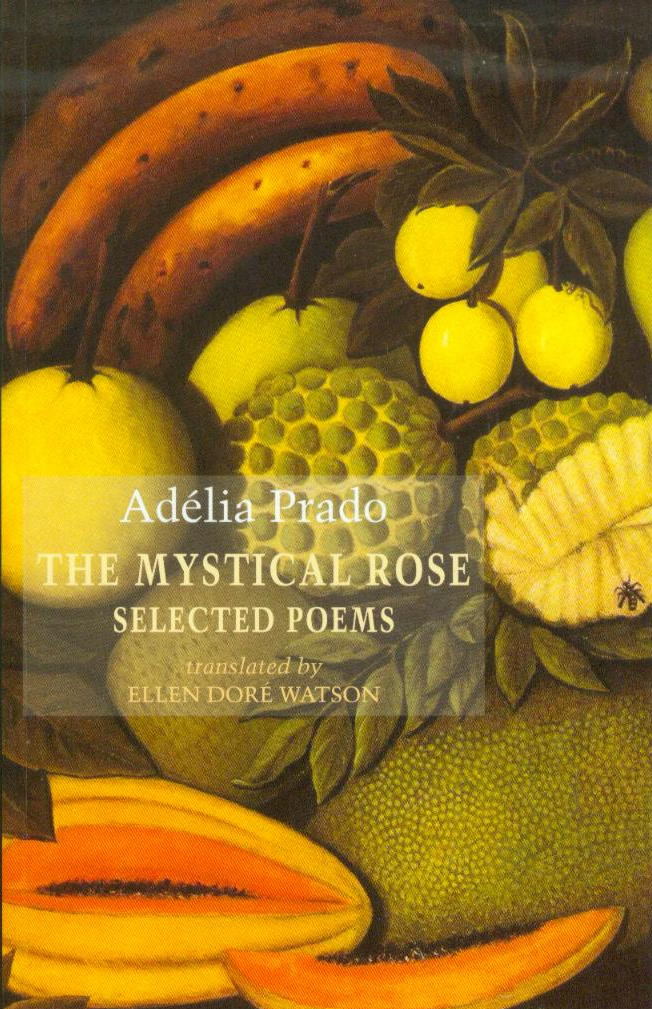
PRADO, Adélia. The Mystical rose. Selected poems. Translated Ellen Doré Watson. Hexburn, Northumberland, England: Bloodaxe Books, 2014. 192 p. Supported by Arts Council England. “ Adélia Prado “ Ex. bibl. Antonio Miranda
GUIDE
Poetry will save me.
I feel uneasy saying this, since only Jesus
is Saviour, as a man inscribed
(of his own free will)
on the back of the souvenir crucifix he brought home
from a pilgrimage to Congonhas.
Nevertheless, I repeat: Poetry will save me.
It's through poetry that I understand the passion
He had for us, dying on the cross.
Poetry will save me, as the purple of flowers
spilling over the fence
absolves the girl her ugly body.
In poetry the Virgin and the saints approve
my apocryphal way of understanding words
by their reverse, my decoding the town crier's message
by means of his hands and eyes.
Poetry will save me. I won't tell this to the four winds,
because I'm frightened of experts, excommunication,
afraid of shocking the fainthearted. But not of God.
What is poetry, if not His face touched
by the brutality of things?
ETERNAL LIFE
Half a century.
The weight of that word used to send me straight to bed.
No more. I'm gathering wisdom.
Alchemists aren't law-breakers —
sure, they're naive sometimes, like the saints,
believing in stones, fish seen in dreams,
signs written on the sky.
Where is God?
April is reborn out in the cosmos,
Ife the most perfect silence.
Inside and outside of me.
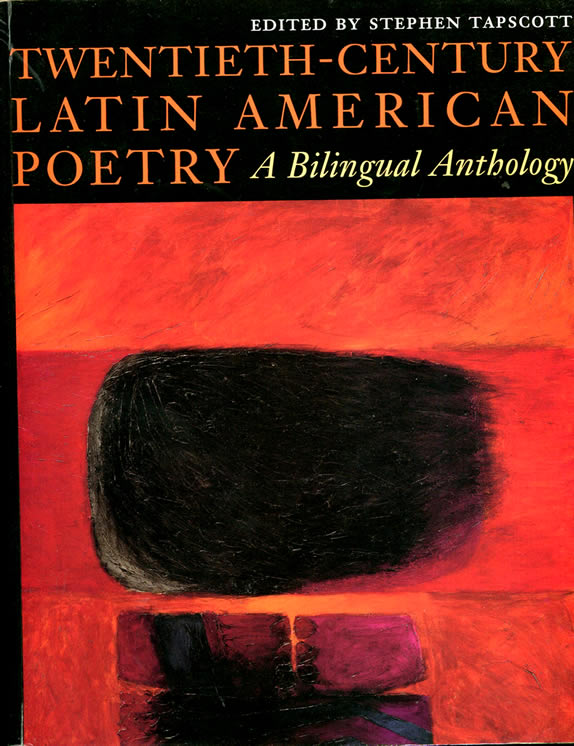
TWENTIETH-CENTURY LATIN AMERICAN POETRY - A Bilingual anthology. Edited by Stephen Tapscott. Austin: University of Texas Press, 1996. 418 p. Ex. bibl. Antonio Miranda, A antologia inclui os seguintes poetas brasileiros: Cruz e Sousa, Manuel Bandeira, Oswald de Andrfade, Mário de Andrade, Jorge de Lima, Raul Bopp, Cecília Meireles, Carlos Drummond de Andrade, Henriqueta Lisboa, João Cabral de Melo Neto, Ferreira Gullar e Adélia Prado. Inclui, ao final, poemas dos concretistas (poesia concreta) originais, em português, de Augusto de Campos, Décio Pignatari, Ronaldo Azeredo e Pedro Xisto, com as palavras (key) em inglês para orientar os leitores estrangeiros.
Inclui os poemas de Adélia Prado: Graça – Grace, Sesta – Siesta; Fluência – Fluency; Vitral – Stained Glass Window; O pelicano – The pelican; Em Português – In Portuguese; We selected two of them:
STAINED GLASS WINDOW
A church facing north
and to its left an embarkment,
a railroad.
The sun, more than half-way west.
There are some boys in the shade.
I’m there with my foot resting on my big toe.
My hand, caressing my hair, come to rest a
quarter of the way up my thigh,
where it bounces and shyly returns like a
dancer’s awkward leap.
Everything is pulsing and revealing to me,
it’s a good as foreplay but not provoked by sex.
An existence this pure.
(Trans. Marcia Kirinus)
IN PORTUGUESE
Spider, cork, pearl
and four more which I won’t say:
these are perfect words.
Dying is inevitable.
God is weightless.
A butterfly is always in transition,
like soap in a boiling kettle.
God knows these are all strange things
that exist in the mind,
corruption exists because of
original sin.
Words, things I‘ve desired before.
My mind tires of this sad oration.
Jonathan said to me:
“Have you eaten your yogurt?”
What sweetness envelops me, what confort!
Words are imperfect, they exist only for poems
and I ask where do
these winged insects and this friendship come from,
your arm brushing up against mine.
(Trans. Marcia Kirinus)
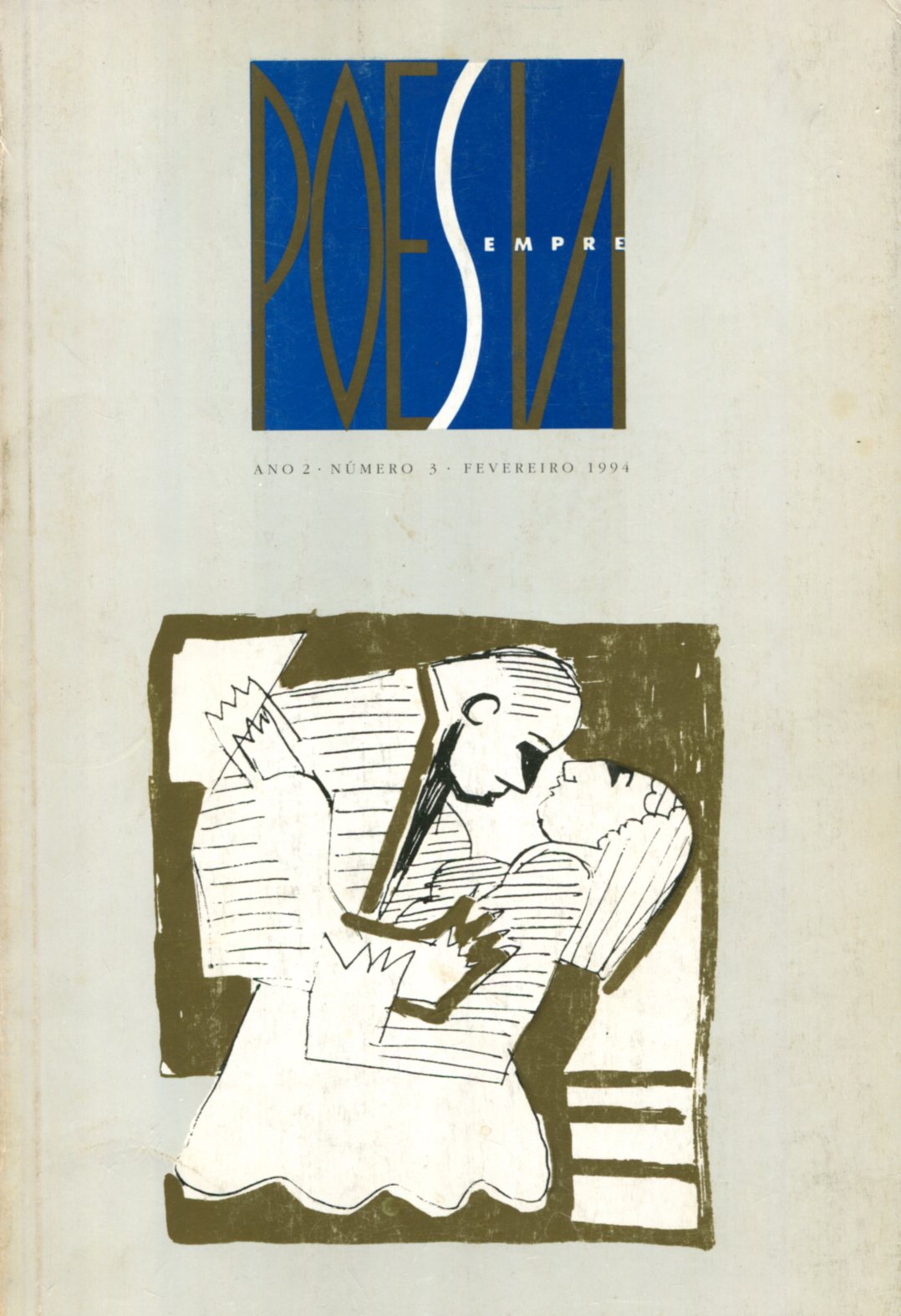
POESIA SEMPRE – Revista Semestral de Poesia – Ano 2 Número 3 – Rio de Janeiro Fevereiro 1994 - Fundação Biblioteca Nacional. ISSN 0104-0626 Ex. bibl. Antonio Miranda
Nightfall < "Anoitecer")
Friends, I sang as a bird sings
at daybreak. In full agreement
with one single world.
But how could one live in a world
where things had a single name?
Then, I made up words.
And words perched, warbling, on the head
of objects.
Reality, thus, came to have as many heads as words.
And when I tried to express sadness and joy words settled upon me, obedient to my slightest lyrical gesture.
Now I must be mute.
I am sincere only when I am silent.
So, only when I am silent
do they settle upon me - words -
a flock of birds in a tree
at nightfall.
Translated by Barbara Howes
Brazilian Poets - Brazil
|