MANUEL BANDEIRA
(1896-1968)
SALUTE TO RECIFE
Recife
Not the Venice of America
Not the Mauritsstad of the merchant adventurers to the
West Indies
Not the Recife of Levantine peddlars
Not the Recife I learned to love afterwards—the Recife
of libertarian revolutions
But a Recife without history or literature
A Recife remarkable for nothing
The Recife of my childhood
Union Street where I played snap-the-handkerchief and broke
the windows of Dona Aninha Viegas' house
Totônio Rodrigues was very old and wore his nose-nippers on
the end of his nose
After dinner the families took their chairs out on the sidewalk
gossiping, making love, laughing
Children played games in the middle of the street
The boys shouted:
Will the rabbit come out ?
Or won't he ?
In the distance the sleek voices of little girls sang slightly off key:
Rose tree give me a rose
Clove tree give me a bud
(Of those roses many a rose
Died in the bud)
Suddenly
far away in the night
a bell
One grown-up person said: Fire in Santo Antonio!
Another, contradicting him, São José!
Totônio Rodrigues insisted it was in São José.
The men put on their hats and went out smoking
And I was furious because I was a child and could not go
to the fire Union Street . . .
What lovely names they had, the streets of my childhood Street
of the Sun
(Nowadays, I fear, it is called after Dr. So-and-so)
Behind our house was the Street of Regretful Longing .
... where I went to smoke on the sly
Not far away, on the water front, was the Street of Dawn .
... where I went to fish on the sly
Capiberibe
—Capibaribe
There beneath the tangled woods of Caxanga
Bath-houses of straw
One day I saw a young woman bathing without a stitch
I stood still with beating heart She laughed
For the first time I was aware
Flood-time! The river-floods! Slime, dead oxen, uprooted
trees submerged in the eddies
And in the whirlpools under the railway bridge the reckless
half-breeds on rafts of banana trees
Novenas
Riding on horses
I lay in the girl's lap and she began to run her hand through
my hair
Capiberibe
—Capibaribe
Union Street where every afternoon the negress with bananas
went by
In her gaudy African shawl
And the man who sold stalks of sugar-cane
And the peanuts
which were called midubim and were not roasted
but boiled
I remember all the street-cries:
Eggs fresh and cheap
Ten eggs for a pataca
That was long ago...
Life did not come to me through newspapers or books
It came on the lips of the people in the rude language
of the people
The apt language of the people
For it is they who speak with gusto the Portuguese of Brazil
To a tune of our own
What we do
Is to ape
The Lusitanian syntax
Life with a parcel of things I did not clearly understand
Countries of whose existence I did not know
Recife...
Union Street...
My grandfather's house ...
Never did I think it would all come to an end!
Everything there seemed imbued with eternity
Recife...
My grandfather dead...
Dead Recife, good Recife, Recife as Brazilian as my
grandfather's house.
Translator: Dudley Poore
IN SOAPSUDS STREET
COME down! Come down, balloon!
Come down! Come down, balloon!
In Soapsuds Street!...
What it cost to contrive that tiny paper balloon!
It was the son of the laundress who made it, A
boy who worked as typesetter on the newspaper and
coughed all the time.
He bought the tissue paper, lovingly cut it, fitted the narrow
sections together ...
Then adjusted the tarred wick to the wire mouthpiece.
Now up it goes,—so small, so touching, in the dusky sky.
It took time to fill.
It swayed, trembled all over and changed color.
The little black brats of Soapsuds Street
Yelled with malice: Come down! Come down, balloon!
Yet suddenly it stretched, filled and pulled away from
the hands that held it
And began to rise ...
higher and higher ...
serenely ...
Buoyant with Jose's phthisic breath.
Come down! Come down, balloon!
The little brats attacked it with slings
jeers
catcalls
stones
Come down! Come down, balloon!
A gentleman warned that balloons were prohibited by city
regulations.
Still, it went on mounting...
ever so calmly ...
ever so high ...
It did not fall in Soapsuds Street.
It fell far away... It fell in the sea, in the pure waves
of the open sea.
Translator: Dudley Poore.
MOZART IN HEAVEN
ON the 5th of December 1791 Wolfgang Amadeus Mozart entered heaven as a circus performer, turning marvelous pirouettes on a dazzling white horse.
The small astonished angels said: Who can that be ? Who in
the world can that be ?
As never-before-heard melodies began to soar
Line after line above the staff.
For a moment the ineffable contemplation paused.
The Virgin kissed him on the forehead
And from then on Wolfgang Amadeus Mozart was the
youngest of the angels.
Translator: Dudley Poore.
THE WOODS
THE woods toss and whirl and writhe and shake themselves
from end to end!
Today the woods have something to tell.
And they howl and strain, root and branch, like an actress in
a tragic play.
Every rebellious branch
Betrays the same frantic anxiety.
All feel the same secret fear.
Or if not, then they are all desperately begging the same
urgent thing.
What do the woods know ? What are the woods beseeching ?
Are they begging water ?
But the water fell in floods only just now, whipping them,
beating them, shaking them without mercy.
Are they begging fire to cleanse themselves of the century-old
dry rot ?
Or do they ask for nothing ? Do they merely wish to speak and cannot ?
Have they surprised the earth's secret through the delicate
ears of their roots ?
The woods toss, whirl, strain and shake from end to end!
Today the woods are like a mob in collective delirium.
Only a single tuft of bamboos, standing somewhat apart,
Sways ever so lightly, so lightly, so very lighdy,
As if smiling at the general madness.
Translator: Dudley Poore.
THE CACTUS
That cactus recalled the despairing gestures of marble:
Laocoön strangled by the serpents,
Ugolino and his famished sons.
It called to mind also the dry northeast, the parched
wilderness, the bush.
It was enormous, even for this land so monstrously fertile.
One day an angry gust uprooted it.
The cactus fell across the street,
Demolished the eaves of the houses across the way,
Obstructed the passage of streetcars, automobiles, wagons;
Tore down the electric wires, and during twenty-four hours
deprived the city of light and power:
It was beautiful, harsh, intractable.
Translator: Dudley Poore.
THE HIGHWAY
THIS street where I live, between two bends of the road,
Is more interesting than a city avenue.
In towns all the people look alike.
Everyone is alike. Everyone is everybody.
Here, not so; it is plain that everyone has a soul of his own.
Every creature is unique,
Even to the dogs.
These country dogs have the air of business men:
They are always preoccupied.
And how many people come and go!
Each with a character so distinct as to start a whole train of
meditation:
The funeral procession on foot or the little milk cart drawn
by a crafty he-goat.
Nor is there lacking a murmur of water, to suggest by the
voice of symbols
That life is passing, that life is passing,
And that youth comes to an end.
Translator: Dudley Poore.
DEAD OF NIGHT
IN the dead of night
Beside the lamp post
The toads are gulping mosquitoes.
No one passes in the street,
Not even a drunkard.
Nevertheless there is certainly a procession of shadows
Shadows of all those who have passed,
Of those who are still alive and those already dead.
The stream weeps in its bed.
The voice of the night...
(Not of this night, but of one yet vaster.)
Translator: Dudley Poore.
--------------------------------------------------------------------------------------
Translated , with the help of Yolanda Leite,
by JOHN NIST
MODERN BRAZILIAN POETRY, AN ANTHOLOGY
Bloomington: Indiana University Press, 1962
POETICA
I am sick of limited lyricism
Of well-behaved lyricism
Of public-servant lyricism
With its time-clock card
And its clearkly protocol
And its ass-kissing flattery of the boss.
I am sick of halting lyricism
That has to look up in the dictionary
The vernacular meaning of a word.
Down with the purists!
I want all the words
Chiefly the universal barbarisms
I want all the constructions
Chefly the syntactical ones of exception
I want all the rhythms
Chefly the unnumbered.
I am sick of flirting lyricism
Of political lyricism
Of rickety lyricism
Of syphilitic lyricism
Of all lyricism which surrenders
To anything which is not its true self.
After all, that is not lyricism
That is only bookkeeping
A table of co-sines
A handbook for the perfect lover
With a hundred models of letters
And the different ways to please the ladies.
I prefer the lyricism of madmen
The lyricism of drunkards
The difficult and poignant lyricism of drunkards
The lyricism of Shakespeare´s fools.
I will have nothing more to do
With a lyricism which is not freedom.
PNEUMOTHORAX
Fever, lung-coughing blood, gasping, and night-seats.
A whole life that could have been, but was not.
Cough, cough, cough.
He sent for the doctor:
— Sat thirty-three.
— Thirty-three… Thirty-three… Thirty-three…
— Breathe.
. . . . . . . . . . . . . . . . . . . . . . . . . . . . . . . . .
— You have a hole in the left lung and seepage into the right.
— Well, doctor, isn´t possible to try a pneumothorax?
— No. The only thing you can do is play an Argentine tango.
MOMENT IN A CAFÉ
When the funeral procession passed by
The man who were in the café
Tipped their hats oh, so mechanically
In perfunctory and absent-minded salute to the dead
For they themselves were all turned toward life
They were swallowed up in life.
They were relying upon life.
One of them, swept off his hat
In the long and slow arc of a gesture
And stared at he hearse:
For this man knew that life is a fierce and simless agitation
That life is a treason
And he paid his respects to the flesh which passed by
Forever freed from the dead soul.
ABSOLUTE DEATH
To die.
To die body and soul.
Completely.
To die without leaving the sad remains of flesh,
Without leaving the bloodless mask of wax,
Surrounded by flowers,
Which will rot away — so happy! — one day,
Bathed in tears
Born less from grief than from the shock of death.
To die without leaving perhaps even a pilgrim soul…
On the way to heaven?
But what heaven can fulfill your dream of heaven?
To die without leaving a furrow, a trace, a shadow,
Without leaving even the remembrance of a shadow
In any human heart, in any human thought,
In any human skin.
To die so completely
That one day when somebody sees your name on a page
He will ask: “Who was he?...”
To die still more completely:
Without leaving even this name.
APPLE
From one angle I see you just like a dried-up breast
From another just like a belly from whose navel still hangs the
umbilical cord
You are red as the divine love
Inside you in the little seeds
Palpitates a prodigious life
Infinitely
And you remain so simple
Beside a knife
In a poor hotel room.
PROFUNDAMENTE
When last night I feel asleep
At the feast of St. John
There was much merriment and noise
Stacatto banging of rockets and lights of Roman candles
Voices songs and laughter
Near the kindled bonfires.
In the middle of the night I awoke
And could no longer hear voices and laughter
Only vagrant balloons
Drifted here and there
Oh, so silently
And from time to time
Only the clatter of the streetcar
Bored through the silence
Like a tunnel.
Where were those who a mere moment ago
Were dancing
Were singing
Were laughing
Near the kindled bonfires?
— They were all asleep
They were all lying down
Sleeping
Oh, so profoundly.
When I was sic years old
I could not see the end of the feast of St. John
Because I fell asleep.
Today I can no longer hear the voices of that time
My grandmother
My grandfather
Totonio Rodrigues
Tomasia
Rosa
Where are they all?
— They are all asleep
They are all lying down
Sleeping
Oh, so profoundly.
ROUNDEL OF THE LITTLE HORSES
The little horses running,
And we, the big horses, eating…
And your beauty, Esmeralda,
Finally drove me mad.
The little horses running.
And we, the big horses, eating…
And the sun outside so bright,
But in my heart night is falling.
The little horses running,
And we, the big horses, eating…
Alfonso Reyes going away,
And so many people staying behind.
The little horses running,
And we, the big horses, eating…
Italy bragging and bullying,
And Europe coming apart at the seams…
The little horses running,
And we, the big horses, eating…
Brazil busy politicking,
My God! Poetry dying…
And the sun outside so bright,
And the sun so bright, Esmeralda,
But in my heart — night is falling!
I AM GOING AWAY TO PASARGADA
I am going away to Pasargada
There I am friend of the king
There I have the woman I want
On the bed that I shall choose
I am going away to Pasargada.
I am going away to Pasargada
Here I am not happy
There life is an adventure
I such a non-mattering way
That Joan the Mad Woman of pain
Queen and pretended insane
Is relative once removed
From the daughter-in-law I never had.
And how I will exercise!
I will pedal my bicycle!
I will ride the wild ass!
I will climb the greased pole!
I will bathe in the sea!
And when I am tired
I will lie on the banks of the river
And call the nymph of the water
To tell me the stories
That Rose used to tell me
When I was a boy
I am going away to Pasargada.
There´s everything in Pasargada
It´s another civilization:
It has s safe and sure way
To prevent knocking the girls up
It has automatic telephone
It has plenty of dope
It has beautiful prostitutes
For one to make love to.
And when I become sadder
So sad that I have no more hope
And when in the night it comes:
The desire to kill myself
— Ah, there I am friend of the king —
Then I have the woman I want
On the bed that I shall choose
I am going away to Pasargada.
LAST SONT OF THE DEAD END
Dead End which I sang in a couplet
Full of mental ellipses,
Dead End of my sorrows,
Of my doubts and my fears
(But also of my loves,
Of my kisses, of my dreams),
Goodbye, goodbye forever!
They are going to tear down this house.
But my room will remain,
Not like an imperfect form
In this world of appearances:
It will remain in eternity,
Which its books, with its pictures,
Intact, suspended in air!
Dead end of the evergreen thorn,
Of the passions with no tomorrows,
How much Mediterranean light
Did not the purity of the mornings
Harvest upon these stones
With the shining of adolescence!
Dead End of my sorrows,
I am not ashamed of you!
Where you a street of the whores?
They all daughters of God!
And before them there were the nuns…
And you belonged to the poor only
When, poor myself, I came to live here.
Lapa — Lapa do Desterro —,
Lapa which sins so much!
(But when six o´clock strikes,
In the first voice of the bells,
What angelic graces you have:
Like in that voice which announced
To Mary the conception of Christ!)
Our Lady of Carmel,
There from the height of the altar,
Is begging for alms for the poor —
For all the sad women,
Who come at night to seek shelter
In the doorways of the church.
Dead End born in the shadows
Of the stone walls of convents,
You are life, life which is holy
No matter how many its falls.
For this I love you always,
And I sing to you to say:
Goodbye, goodbye forever!
THE MORNING STAR
I want the morning star
Where is the morning star?
My friends my enemies
Hunt for the morning star
Naked she vanished
Vanished with whom?
Seek her everywhere
Call me a man without pride
A man who puts up with everything
What do I care?
I want the morning star
Three days and three nights
I was assassin and suicide
Thief, pimp, forger
O evil-sexed virgin
Tormentor of the afflicted
Two-headed giraffe
Sin for us all sin with us still
Sin with the hoods
Sin with the cops
Sin with the marines
Sin every way possible
With the Greek and with the Trojans
With the priest and with the sexton
With the leper from the isolation ward
And then with me
I will wait for you with amusement parks carnivals rodeos
I was eat earth and say things
of such simple tenderness
That you will swoon
Hunt for her everywhere
Pure or degraded to the uttermost vileness
I want the morning star.
=============================================================================
From
AN ANTHOLOGY OF TWENTIETH-CENTURY BRAZILIAN POETRY.
Sponsored by the Academy of American Poets.
Middletown, Conn.: Wesleyan University Press, 1972.
MY LAST POEM
Translated by Elizabeth Bishop
I would like my last poem thus
That it be gentle saying the simplest and least intended things
That it be ardent like a tearless sob
That it have the beauty of almost scentless flower
The purity of the flame in which the most limpid diamonds are consumed
The passion of suicides who kill themselves without explanation.
ANTHOLOGY
Translated byJean R. Longland
Life
Is not worth the trouble and grief of being lived.
Bodies understand each other, but souls, no.
The only thing to do is to play an Argentine tango.
I'm going away to Pasárgada!
I am not happy here.
I want to forget it all:
— The grief of being a man. . .
This infinite and vain anxiety
To possess what possesses me.
I want to rest
Thinking humbly about life and women I loved . . .
About all the life that could have been and wasn't.
I want to rest.
To die.
To die, body and soul.
Completely.
(Every morning the airport across the way gives me lessons
in departure.)
When the Undesired-of-all arrives,
She will find the field plowed, the house clean,
The table set,
With everything in its place.
This poem is a cento. The word cento has nothing to do with "hundred"
but comes from the Latin cento, centonis, which means a patchwork quilt. . . .
I had the idea of constructing a poem out of nothing but lines or parts of lines of
mine, the best known or most marked by my sensibility, which at the same time
could function as a poem for a person who knew nothing of my poetry. (From a
letter of Manuel Bandeira to Odylo Costa Filho)
RONDEAU OF THE LITTLE HORSES
Translated by Richard Wilbur
The little horses trotting
While we're horsing around and eating .
Your beauty, Esmeralda,
Became intoxicating.
The little horses trotting
While we're horsing around and eating .
The sun out there so brilliant
That in my soul — is setting!
The little horses trotting
While we're horsing around and eating …
Alfonso Reyes departing
And all the rest still sitting . . .
The little horses trotting
While we're horsing around and eating . .
Italy shouting defiance
And Europe afraid of fighting . . .
The little horses trotting
While we're horsing around and eating . .
Brazil orating, debating,
Poetry dead and rotting ...
The sun out there so brilliant,
The bright sun, Esmeralda,
That in my soul — is setting!
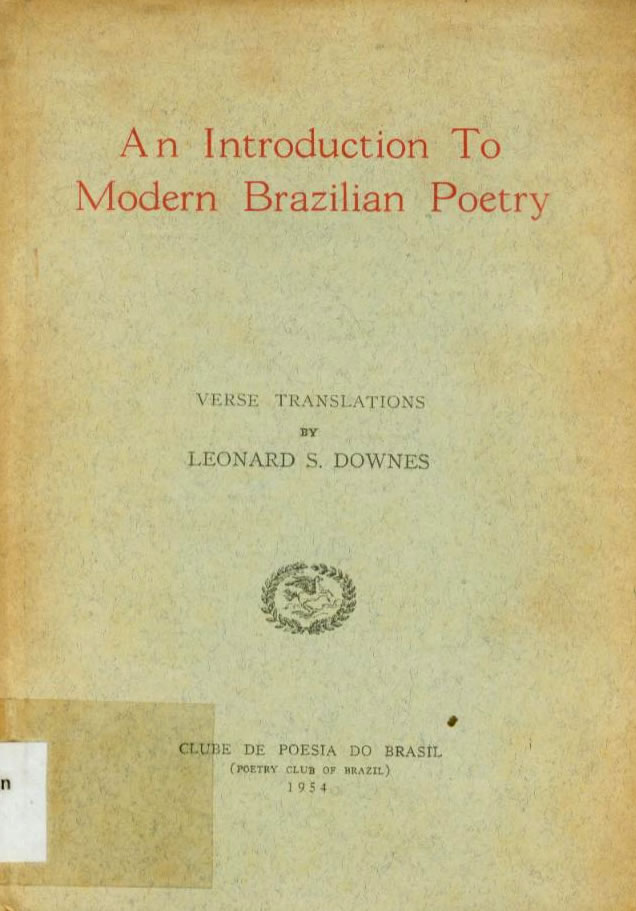
AN INTRODUCTION TO MODERN BRAZILIAN POETRY. Verse translations by Leonard S. Downes. [São Paulo]: Clube de Poesia do Brasil, 1954. 84 p. 14x20 cm. “ Leonard S. Downes “ Ex. Biblioteca Nacional de Brasília.
SONG OF THE WIND AND MY LIFE
The wind swept away the leaves
The wind swept away the fruits
The wind swept away the flowers
And still my life was left
Fuller than ever
Of flowers fruits and leaves.
The wind swept away the lights
The wind swept away the music
The wind swept away the perfumes
And still my life was left
Fuller than ever
Of perfumes star and songs.
The wind swept away my dreams
And swept away too my friends…
The wind swept away my women…
And still my life was left
Fuller than ever
Of loves and women.
The wind swept away the months
And swept away too your similes…
The wind swept all away!
And still my life was left
Fuller than ever
Of everything.
Página publicada em janeiro de 2009; página ampliada e republicada em agosto de 2015;
ampliada em outubro de 2016
.
|